Moonshot
 Higgsfield
 Orgn
 42dot
 Robocore

Lights-Out Manufacturing and the Return of American Industry
Robotics and AI are letting factories run longer with less supervision. Lights-out manufacturing could lower costs, raise output, and help American industry compete again.
Companies Already Putting It Into Practice
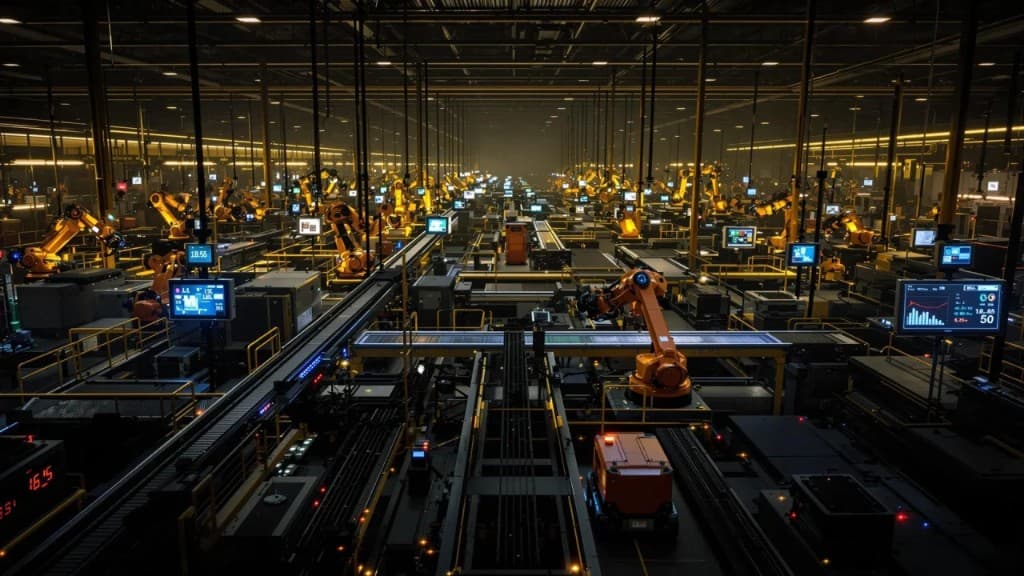
American manufacturing has an opportunity to produce far more than it does today without needing to expand its workforce at the same rate. Robotics and AI are making it possible for factories to run production lines for extended periods with minimal human supervision. This approach, commonly called lights-out manufacturing, allows machines to handle much of the work that once required employees to be physically present throughout every shift. As the technology becomes more accessible, it could change the economics of manufacturing in the United States, giving companies of all sizes the ability to increase production, lower costs, and compete in a global market.
Lights-out manufacturing is already being used in several industries. FANUC, a Japanese robotics manufacturer, has operated highly automated production at its facilities for extended periods with little human intervention. Its factories use robots to manufacture other robots, demonstrating how automation can be applied throughout the production process.
American manufacturers are also adopting parts of this model. KAD Models, a CNC machining company, has used robotic machine tending to keep equipment running overnight. Instead of requiring an employee to load and unload every machine throughout the night, robotic systems can handle those tasks while production continues.
HIROTEC America has also pursued greater automation in its automotive manufacturing operations, with the goal of expanding production beyond conventional working hours. These examples show that lights-out manufacturing is not limited to enormous technology companies. Smaller manufacturers can automate specific processes and gradually expand as their operations grow.
Lower Costs and Greater Production
One of the biggest advantages of lights-out manufacturing is the ability to get more production out of existing equipment. A factory that operates only during standard working hours leaves much of its potential production time unused. Automated systems can keep machines running overnight and on weekends, increasing output without requiring additional shifts of employees.
This can lower the cost of producing each unit. The initial investment in automation may be substantial, but companies can spread that cost across a larger volume of goods. They may also reduce expenses associated with repetitive manual tasks, production interruptions, and certain types of defects.
Automation can improve consistency as well. Machines can repeat the same operation with a high degree of precision, while sensors and camera systems can inspect products and identify problems during production. Software can monitor equipment performance and alert operators when maintenance is needed.
When companies can produce components and finished goods at lower cost, other businesses benefit from cheaper inputs. Lower manufacturing costs can support lower prices, business expansion, and greater availability of products.
Making Automation Affordable for Smaller Manufacturers
A common assumption is that automated manufacturing requires a massive investment in an entirely new factory. In practice, companies can start with a much smaller project. A manufacturer might begin by installing a robotic arm that loads and unloads a CNC machine. Another might automate product inspection or material handling.
These targeted upgrades can reduce the need for employees to perform repetitive tasks and allow equipment to operate for longer periods. Once a company sees a return on its investment, it can automate additional parts of the production line.
The main costs include robots, machine tools, sensors, software, installation, and integration. The price varies widely depending on the equipment and complexity of the operation. A simple robotic machine-tending system will cost considerably less than a fully automated production facility.
Businesses can also reduce upfront costs by purchasing used industrial robots, leasing equipment, or working with automation companies that design systems around existing machinery. They do not necessarily need to replace their entire production setup. In many cases, the most practical approach is to identify the task that creates the greatest bottleneck and automate that first.
The financial calculation comes down to how much additional production the equipment can generate compared with its purchase, installation, and maintenance costs. If a machine can operate through the night without requiring someone to load and unload it manually, the company gains productive hours from equipment it already owns.
This could be especially useful for smaller American manufacturers. A business that cannot afford to hire dozens of additional employees may still be able to expand production through automation. It can increase its capacity without having to grow its workforce at the same rate.
How American Factories Can Make the Transition
Manufacturers do not need to move directly to fully automated facilities. They can introduce automation in stages. The first step is identifying repetitive tasks that can be handled reliably by machines. Loading materials, moving components, operating CNC equipment, and inspecting finished products are common starting points.
From there, companies can connect machines to monitoring software and introduce systems that coordinate production. Machine vision can check product quality, while predictive maintenance tools can help identify equipment problems before they cause lengthy interruptions. AI can also help with production scheduling and identifying inefficiencies.
As these systems become more capable, factories can operate for longer periods with fewer people on the production floor. Employees can supervise multiple machines rather than spending their entire shifts operating one piece of equipment.
This gradual approach gives businesses time to learn how the technology works and build the skills needed to maintain it. It also allows them to expand automation based on actual results rather than making a large investment all at once.
A Different Future for Manufacturing Workers
The growth of automation will change the types of jobs factories need. Some repetitive positions will become less necessary as machines take over individual tasks. At the same time, automated facilities still require people to operate and maintain equipment, oversee production, troubleshoot problems, and manage the systems that keep factories running.
Workers can transition into roles involving robotics, machine maintenance, industrial software, quality control, and facility supervision. Manufacturers will need employees who understand how the equipment works and can respond when something goes wrong. Training existing workers for these responsibilities can help companies make the transition while retaining valuable experience.
The goal is to increase the amount of work a factory can accomplish while shifting human effort toward tasks that require judgment, technical knowledge, and problem-solving.
Building More Productive American Industry
Lights-out manufacturing could help make domestic production more competitive. If American companies can manufacture goods at lower costs and operate equipment for more hours, producing certain products in the United States becomes more financially attractive. That could reduce dependence on overseas suppliers and give domestic businesses greater control over their production.
It also creates an opportunity for smaller manufacturers. A company no longer needs to hire a large workforce before it can increase its output. With the right equipment, a smaller operation can produce more while keeping its staffing requirements manageable.
As robotics and AI continue to improve, automation will become an increasingly important part of industrial growth. More production capacity means more goods, stronger supply chains, and greater opportunities for businesses to expand. The United States has the technology and industrial base to make this transition. Widespread adoption could help create a manufacturing sector capable of producing more with fewer constraints, supporting a more abundant and productive economy.
Sources
Published: Oct 12, 2026